
THE CONTENTS OF THE FOLLOWING PAGE ARE FOR INFORMATIONAL PURPOSES ONLY AND ARE NOT A SUBSTITUTE FOR DIAGNOSIS, MEDICAL ADVICE OR RECOMMENDATIONS.
PLEASE CONTACT YOUR TREATMENT TEAM FOR MORE INFORMATION.
Better avoidance of nerve injury during removal of thyroid cancer
 Thyroid
Thyroid cancer
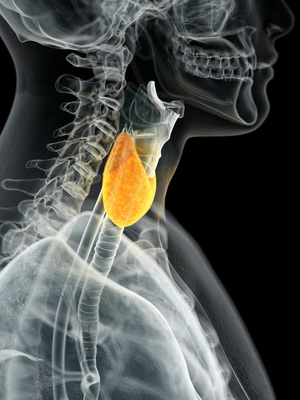
Surgical removal of thyroid cancer involves the risk of injury to the vocal cord nerve (recurrent laryngeal nerve), which is located in the surrounding tissue of the thyroid. The use of IONM devices during surgery allows the surgeons to localise the nerve and to monitor its function. The risk of nerve damage during the surgical treatment of thyroid cancer can thus be significantly reduced for patients.[1]
Protection of the vocal cords through intraoperative neuromonitoring
During the surgical treatment of thyroid cancer, but also during other surgical procedures on the thyroid, there is a risk of injury to the vocal cord nerves. These nerves run along the back of the thyroid and are particularly at risk due to their close proximity to the surgical field. Intraoperative monitoring of these nerves can significantly reduce the risk of damage during surgical removal of thyroid cancer. Injury to the vocal cord nerves due to pressure, tension or bruising can result in paralysis of patients’ vocal cords after surgery. This can result in temporary hoarseness to acute respiratory distress with bilateral paralysis.
IONM procedure during thyroid cancer removal
The function of the vocal cord nerves can be monitored either intermittently or throughout the surgery with a neuromonitoring device as follows:
>> Placement of surface electrodes on the inner laryngeal muscles (vocal muscle) to record the nerve signals
>> Delivery of minimal electrical impulses (stimuli) to the vocal cord nerve via a stimulation probe
>> Transmission of the stimulation signals to the inner laryngeal muscles, causing the muscles to contract
>> Recording of the resulting signals by the electrodes placed on the inner laryngeal muscles
>> Evaluation of the signals by the neuromonitoring device
>> The IONM device reports acoustic and optical signals indicating when the vocal cord is intact and when it is compromised. This control function allows the surgeons to adjust the surgical procedure at an early stage if the nerve is at risk, without damaging the nerve.
>> Intraoperative neuromonitoring is not only used during the removal of thyroid cancer, but can also be used in the field of ear, nose and throat surgery in a risk-minimising manner.[2] Parotid gland tumours >>
Diseases
Navigation:
| Continue to head |
| Go back to the overview for patients |