
THE CONTENTS OF THE FOLLOWING PAGE ARE FOR INFORMATIONAL PURPOSES ONLY AND ARE NOT A SUBSTITUTE FOR DIAGNOSIS, MEDICAL ADVICE OR RECOMMENDATIONS.
PLEASE CONTACT YOUR TREATMENT TEAM FOR MORE INFORMATION.
Intraoperative neuromonitoring (IONM) for removal of brain tumours
 Head
Head
Brain tumour
Removing a brain tumour surgically requires a precise approach, as surgery is performed in a highly sensitive neurological field. Continuous monitoring of the nervous system helps to make the surgery safer and protect patients from consequential damage.
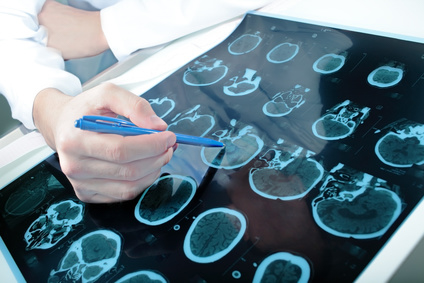
Surgery as a treatment for brain tumours
Surgical removal is one option to treat a brain tumour. Other therapeutic options depend on the tumour type and include radiation and chemotherapy.
Usually, the best treatment option is decided by a board of different specialists to find the optimal strategy for each patient. Surgery allows for precise diagnosis by taking tumour specimen which can then be analysed by pathologists. If the tumour puts too much pressure on the brain, surgery can be life-saving.
Find out about the best possible professional care at one of the neurosurgical hospitals.
Use of IONM for brain tumours, e.g. vestibular schwannomas
Vestibular schwannomas are brain tumours for which IONM is often used to minimise damage to nervous tissue. Neurinomas generally refer to benign tumours, i.e. they grow slowly and do not form metastases.
Vestibular schwannomas develop on the vestibular portion of the vestibulocochlear nerve, the connective nerve between the internal auditory canal and the brainstem. The tumour thus impairs the function of the cochlear and auditory nerve, but can also affect the facial nerve, which also runs through the internal auditory canal.
IONM of the nerve structures is performed by continuously measuring EMG (electromyography) and AEP signals (acoustically evoked potentials). Additionally, MEP (motor evoked potentials) and SEP (somatosensory evoked potentials) can be useful.
EMG signals can be used to monitor the muscle activity of the facial nerve:
>> Placement of recording electrodes, e.g. on the eye or mouth muscles
>> Direct nerve stimulation by delivering minimal electrical stimuli via a stimulation probe
>> Transmission of the stimulation signals to the eye or mouth muscles, causing them to contract
>> Recording and display of the resulting signals by the IONM device
The AEP signals allow monitoring of the hearing function:
>> Placement of plug-shaped stimulation electrodes in the ear canal (non-invasive)
>> Acoustic stimulation of the vestibular and auditory nerve via clicking sounds
>> Electrical transmission of the stimulus response through the auditory nerve to the auditory cortex
>> Recording and display of the resulting signals by the neuromonitoring device
In addition to brain tumours and their surgical removal, IONM is also frequently used in thyroid surgery, e.g. for thyroid cancer.